
Gartner has repeatedly noted that enterprise technology projects often struggle because of planning gaps, data complexity, and integration challenges rather than software alone. SAP migration projects illustrate this pattern clearly. Discussions around these projects often focus on system features, deployment schedules, and user training. Yet many migration problems begin much earlier, hidden beneath the surface in storage infrastructure and data management decisions.
Despite the attention given to software implementation, many organizations discover that cloud storage creates unexpected pressure points during migration efforts. Industry perspectives from a top SAP partner highlight how migration planning increasingly involves broader infrastructure concerns rather than software deployment alone. The discussion has gradually shifted from moving applications to understanding how data is organized, transferred, stored, and maintained across environments.
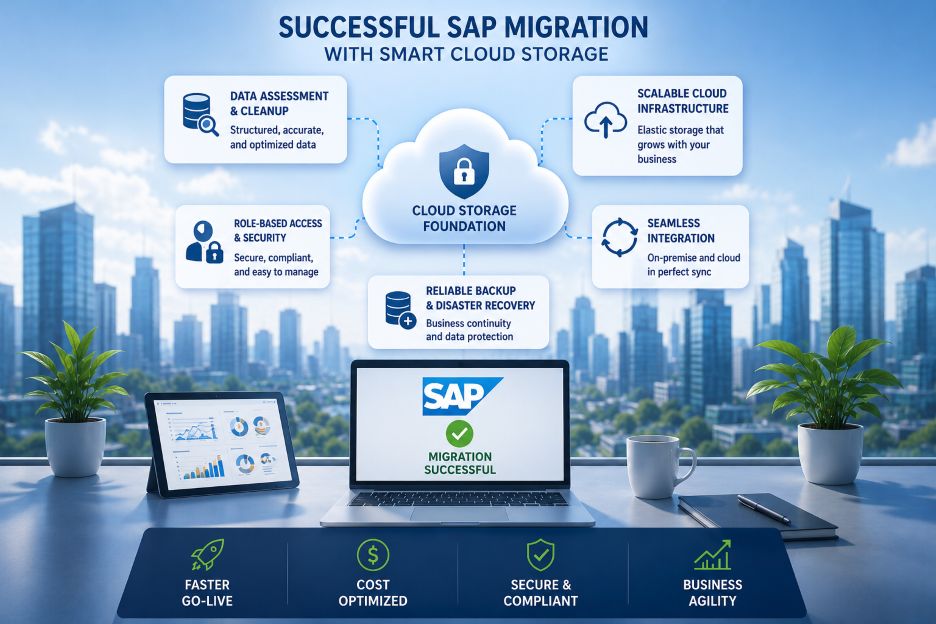
Why SAP Migration Discussions Often Focus on the Wrong Problems
Businesses usually enter migration projects with understandable priorities. Teams discuss project budgets, implementation timelines, workflow design, and employee training plans. These areas receive immediate attention because they are visible and directly tied to business operations.
Storage architecture rarely receives the same level of attention during early discussions. The issue often appears technical and distant from day-to-day business decisions. However, storage systems affect nearly every aspect of migration activity.
Large organizations collect data for years. Customer records, invoices, archived documents, employee files, and operational logs continue to grow over time. By the time migration begins, businesses may be handling millions of files spread across different systems and locations.
These hidden layers create a challenge. The migration itself may proceed exactly as planned, while the data supporting the system introduces unexpected obstacles.
The Storage Challenges Businesses Rarely Anticipate
Legacy Data Often Lacks Structure
Older systems frequently accumulate information without a consistent strategy. Duplicate records appear over time. File naming conventions change between departments. Some data remains untouched for years while still consuming storage resources.
Research from IBM suggests that poor data quality creates measurable operational costs for organizations. During migration projects, this issue becomes even more visible because businesses suddenly examine information that has quietly accumulated for years.
Imagine transferring thousands of customer files into a new environment only to discover conflicting records or missing information. The software itself may function perfectly, yet data inconsistencies create delays.
Data Volumes Become Larger Than Expected
Migration teams frequently estimate active database sizes while overlooking supporting files, archives, attachments, and historical records. Small miscalculations can become significant once migration starts.
International Data Corporation (IDC) projects continuous growth in global enterprise data volumes as organizations expand digital operations. Data growth rarely follows a straight line. Businesses generate reports, communication records, multimedia content, and customer interactions every day.
As a result, migration schedules built around initial estimates can quickly become unrealistic.
Permission Structures Become Complicated
Storage concerns extend beyond capacity. Access management creates another challenge that organizations frequently underestimate.
Different departments require different levels of access. Finance teams handle sensitive records. Human resources departments manage employee information. Operations teams may require broader visibility.
When organizations combine older systems with cloud-based environments, permission structures sometimes overlap or conflict. These issues can create security risks or disrupt employee workflows after migration.
The National Institute of Standards and Technology (NIST) emphasizes the importance of carefully managing access controls within cloud environments because data security depends heavily on permission structures.
Hybrid Environments Add Another Layer of Complexity
Many organizations do not completely replace old systems during migration. Instead, they operate in hybrid environments where some data remains on internal systems while other information moves to cloud platforms.
This arrangement offers flexibility, although it introduces additional coordination challenges.
Data synchronization becomes more difficult. Information may update in one system while remaining unchanged elsewhere. Teams can unknowingly work with outdated records, creating confusion and inefficiencies.
These challenges underscore a larger reality. Migration projects increasingly involve balancing multiple environments rather than performing a simple transfer from one location to another.
What Experienced SAP Ecosystem Providers Learn From Migration Failures
Organizations involved in large implementation projects often observe similar patterns after reviewing unsuccessful migrations.
One recurring lesson involves preparation. Businesses sometimes focus heavily on deploying software while treating storage planning as a secondary task. Yet infrastructure decisions shape long-term performance and operational stability.
Experienced ERP implementation specialists frequently emphasize early data assessments before migration begins. Understanding where information exists, how much inactive data remains, and how files interact with business processes reduces uncertainty later.
Backup planning also plays an important role. Data loss events remain uncommon, although risk still exists during complex migrations. Businesses increasingly develop layered backup strategies to protect information throughout transition periods.
Cloud consultants and enterprise integration teams have also learned that scalability deserves attention from the beginning. Storage requirements rarely stay static after implementation ends. Systems continue evolving as businesses grow.
Cloud Storage Decisions Affect More Than Storage Capacity
Storage discussions often focus on space alone. Capacity matters, but other factors carry equal importance.
Performance affects daily operations. Slow access to records can reduce productivity across departments. Delays measured in seconds may seem small individually, yet repeated interruptions create larger operational consequences.
Collaboration also depends heavily on data accessibility. Modern work environments frequently involve distributed teams operating across locations and time zones. Employees expect fast and reliable access to information regardless of physical location. Discussions around business cloud storage environments increasingly focus on balancing accessibility, security, and long-term scalability as organizations expand their digital operations.
Business continuity introduces another consideration. McKinsey & Company has discussed how resilient digital systems increasingly influence organizational stability and long-term adaptability. Storage systems support recovery efforts during disruptions and help maintain operational continuity.
For this reason, migration planning extends beyond technical deployment activities. Storage infrastructure influences how people work long after implementation teams leave.
Conclusion
Many SAP migration conversations begin with software and end with implementation timelines. However, failed projects often reveal a different story. Hidden infrastructure challenges, data complexity, and storage planning gaps frequently shape outcomes more than expected.
Enterprise solution providers, ERP specialists, and implementation teams increasingly recognize that successful migrations depend on understanding the systems supporting business data. Software remains essential, yet information must move efficiently, remain accessible, and scale with changing business needs.
As organizations continue expanding cloud operations, storage decisions may become less of a background technical discussion and more of a strategic business consideration. The lessons emerging from migration experiences suggest that success often depends on what businesses prepare before systems ever go live.